
Dramaturg's Note on “Shakespeare in Love”
July 6, 2026
By Amanda Giguere, Colorado Shakespeare Festival Dramaturg
Colorado Shakespeare Festival's dramaturgs research the historical, cultural and literary context of a play, helping illuminate its themes, language and relevance for today's audiences.
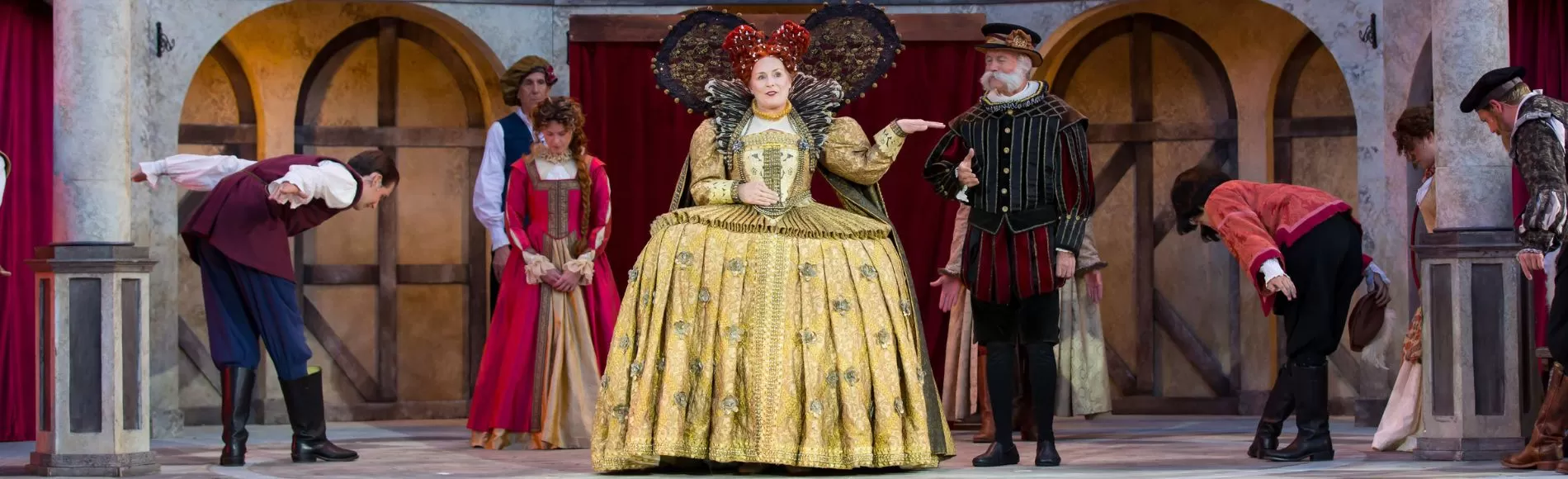
Shakespeare in Love takes place in 1593 London. Based on Tom Stoppard and Marc Norman’s 1998 Academy Award-winning film, Lee Hall’s 2014 stage adaptation blends historical facts with creative embellishments. So what was London like in 1593?
Queen Elizabeth I, nearly 60, had ruled England for more than three decades, and regularly invited players to perform for her at court. Professional theatre was flourishing, though the public playhouses were highly regulated by Edmund Tilney, Master of the Revels. The Lord Admiral’s Men, featuring leading actor Ned Alleyn, performed in the Rose Theatre, which was owned by Alleyn’s father-in-law, Philip Henslowe. Henslowe’s meticulous record-keeping (known as Henslowe’s Diary) provides present-day scholars with vital details about early modern theatre management.
Christopher Marlowe was one of the most celebrated Elizabethan playwrights. Born the same year as Shakespeare (1564), Marlowe was known for his innovative blank verse (unrhymed iambic pentameter). Marlowe’s Tamburlaine and Doctor Faustus were enormously popular, with Alleyn likely originating the eponymous roles. Marlowe was killed in a tavern brawl in May 1593 in Deptford. Scholar Stephen Greenblatt’s book, Dark Renaissance (2025), explores Marlowe’s side-hustle in espionage.
In 1593, Shakespeare was likely a hired player, rather than a shareholder. He had written The Taming of the Shrew, Two Gentlemen of Verona, Titus Andronicus and the Henry VI plays, but many more were to come (Twelfth Night, Hamlet, The Tempest). The Lord Chamberlain’s Men was formed in 1594, with Shakespeare as a founding member. The Globe Theatre did not exist yet (that wouldn’t happen for another six years).
Plague outbreaks were a major obstacle to the professional playhouses. During the 1592-3 outbreak, 10% of London’s population died of the plague, and the theatres were closed. During the closures, some players toured the provinces, while some playwrights turned to poetry.
433 years later, what has changed? As contemporary theatre-makers can attest, it’s still a mystery how plays come together. Despite seemingly insurmountable obstacles, artisans collaborate to make the impossible possible. Audiences show up. The dog steals the scene. And somehow, it always works out in the end.
Tickets for CSF’s 2026 production of Shakespeare in Love are on sale now at coloradoshakes.org.